Mobile – 07850 256393

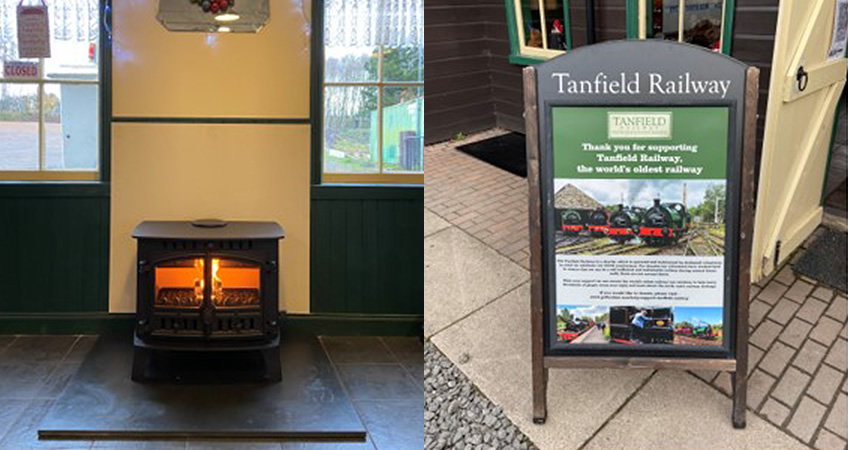
The Tanfield Railway is a standard gauge heritage railway in Gateshead and County Durham, England. Running on part of a former colliery wooden wagonway, later a steam railway, it operates preserved steam and diesel industrial tank locomotives. The railway operates a passenger service on Sundays all year round, as well as demonstration freight trains. The line runs 3 miles (4.8 km) between a southern terminus at East Tanfield, Durham, to a northern terminus at Sunniside, Gateshead, with the main station, Andrews House situated near to the Marley Hill engine shed. A halt also serves the historic site of the Causey Arch. The railway claims to be the oldest working railway in the World.
Preservation:
The early years of the railway as a preservation project concentrated on Marley Hill, preparing locos for steaming, working on the shed structure and acquiring basic needs such as water and electricity. Locomotives No.21 and Malleable No.5. were steamed in public in 1973. The first passenger train ran for a week August 1975, using locomotives No.21, No.32 and Sir Cecil A Cochrane, and a small carriage acquired from British Steel on Teesside.
Part of the reason the line was preserved was the fact Marley Hill shed remained open until 1970. The vintage machinery in the workshop is still capable of full locomotive overhauls. The oldest locomotive on the railway was built in Gateshead in 1873, and all of the railway’s carriage stock dates from the 19th Century.
Causey Arch:
The current preserved line passes near to Causey Arch, the oldest surviving railway bridge in the world. It was built to carry a new branch from the route of the now preserved line, to a site known as Dawson’s Drift. Built between 1725 and 1727, at 150 ft long (46 m) and 80 ft high (24 m), it was the largest single-span bridge in Britain, and remained so for 30 years.